
This text explores the fascinating and sometimes absurd reasons behind the repeated attempts to ban coffee in Sweden during the 18th and 19th centuries. From economic arguments to health claims and even accusations of subversive activity, it examines the various motives that drove these bans and their impact on Swedish society.
Coffee prohibition in Sweden in the 18th and 19th centuries
The history of coffee in Sweden is a story of failed bans, economic interests and a growing love for the dark drink. During the 18th and 19th centuries, the Swedish state tried to ban coffee on several occasions, with varying degrees of success. The reasons for these bans were many and complex, reflecting a mix of economic, political and medical considerations.

The import ban on coffee
One of the main arguments for banning coffee was economic. Under mercantilism, the dominant economic theory of the time, it was considered important to reduce imports and increase exports to strengthen the country's economy. Coffee was an imported commodity, and its popularity meant that large sums of money left the country to pay for it. By banning coffee, it was hoped to reduce imports and thus keep more money within the country.
Coffee drinking's competition with domestic drinks
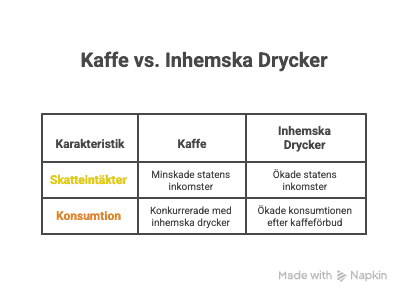
Another economic argument was that coffee drinking competed with the consumption of domestic drinks, such as beer and spirits. These drinks were taxed, and the state therefore saw a drop in tax revenue as coffee became increasingly popular. By banning coffee, it was hoped to increase consumption of the taxed beverages and thus increase government revenue.
Health myths and coffee bans in Sweden
In addition to the economic arguments, health-related claims were also put forward to justify the coffee bans. Coffee was considered by some to be harmful to health and to cause a variety of diseases. There were doctors and other authorities who warned of the negative effects of coffee on the nervous system, stomach and other organs. These claims, often without scientific basis, helped to create a negative image of coffee and strengthen the case for a ban.
Views on the health effects of coffee were divided. There were also those who believed that coffee had positive effects, such as increasing alertness and improving digestion. The medical debate on the health effects of coffee was complex and characterized by a lack of scientific knowledge and conflicting opinions.
Political motives and distrust of Kaffehus
The political motives behind coffee bans may not have been as pronounced as the economic and health arguments, but they still played a role. At times, coffee houses were seen as places where political ideas were discussed and where opposition groups could gather. This made the state see coffee as a potential threat to political stability. By banning coffee, it was hoped to limit opportunities for subversive activity and maintain control over the population.

Gustav III's coffee experiment
One of the most curious examples of the absurd consequences of the coffee ban is Gustav III's coffee experiment. Known for his eccentric ideas, the king wanted to scientifically prove the harmful effects of coffee. He ordered that two twins, both sentenced to death, have their sentences commuted to life imprisonment on condition that one drank coffee every day and the other tea. The experiment went on for many years, but ironically both doctors overseeing the experiment died before the twins. The tea-drinking twin died only at the age of 83, while the coffee-drinker lived even longer. So the experiment did not provide evidence of the harmfulness of coffee, but rather the opposite.
Resilient coffee drinking
Despite repeated attempts to ban coffee, the state never succeeded in completely eradicating coffee drinking in Sweden. The bans were often ineffective and difficult to enforce. Coffee was smuggled into the country and sold illegally, and many Swedes continued to drink coffee in secret. Coffee had become a part of Swedish culture, and it was difficult to persuade people to give up their beloved beverage.
From coffee prohibition to the rise of coffee - How coffee culture triumphed in Sweden
Coffee bans in Sweden were finally lifted in the 19th century. The economic arguments for the bans lost their force as mercantilism was replaced by free trade ideas. The health claims about the harmfulness of coffee were refuted by scientific studies. And the political reasons for the bans disappeared as society became more democratic and tolerant.
Today, coffee is one of the most popular drinks in Sweden. Swedes are among the most coffee-drinking peoples in the world, and coffee has a central place in Swedish culture. From the traditional “fikan” to the modern coffee bars, coffee is an integral part of Swedish society. The failure of coffee bans is a reminder that it is difficult to ban a drink that has won the hearts of the people.